

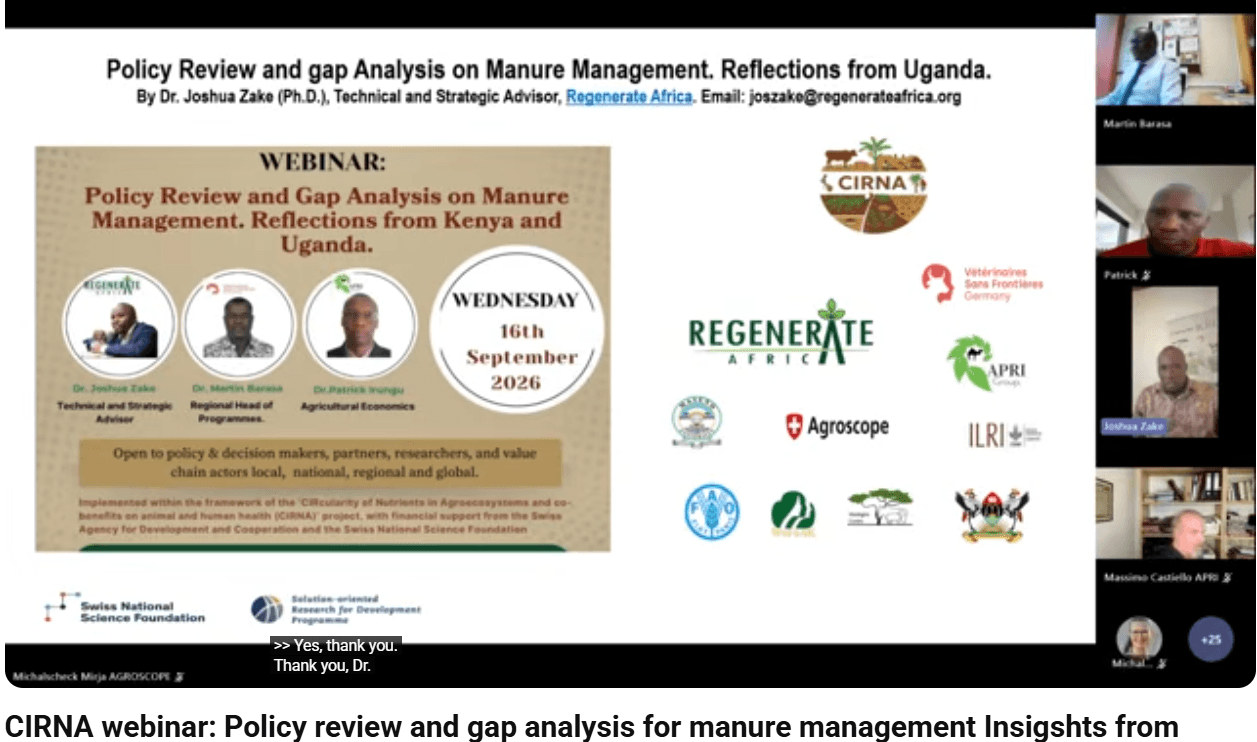
Great and timely reflections from Kenya and Uganda on sustainable manure management
On 16 September 2026, Regenerate Africa, in collaboration with VSF Germany (VSFG), convened a webinar to share findings from a Policy Review and Gap Analysis on Manure Management in Kenya and Uganda.
The webinar provided an opportunity to disseminate findings on the existing policy landscape, key emerging issues, underlying challenges and opportunities, as well as targeted and actionable recommendations for strengthening manure management.
Livestock manure: a resource with untapped potential
Livestock manure is more than waste. When properly managed, it can provide important benefits for farmers, communities and the environment, including:
- Improving soil fertility and crop productivity through its use as an organic fertiliser.
- Supporting biogas and energy production, creating opportunities for cleaner energy and resource recovery.
- Contributing to circular and regenerative agricultural practices by returning valuable nutrients to farming systems.
However, inadequate manure management can also create significant health and environmental risks. Poorly managed manure may contain disease-causing pathogens such as E. coli and Salmonella, while contributing to the pollution of soil, water and air and generating greenhouse gas emissions.
The webinar highlighted the need to move beyond business-as-usual approaches and promote safe, sustainable and resource-efficient manure management practices, supported by effective policies, investments and implementation mechanisms.
The discussions brought together perspectives and experiences from Kenya and Uganda, providing important insights into how policy and practice can better harness the benefits of livestock manure while reducing associated health and environmental risks.
Watch the webinar recording to explore the findings and recommendations:
https://youtu.be/eq_dKCmJTT4