
Zzitwe and Kkoba Parishes, Ssi-Bukunja Sub-county, Buikwe District, Uganda | October 2026
Some health services do not wait for people to come to them. They travel. This October, Regenerate Africa took an integrated medical outreach to Zzitwe Primary School in Buikwe District, bringing care, conversation and clean water to families who live far from the nearest health facility. Four Adult Nursing students from the University of East London, on a two-week civic engagement internship with Regenerate Africa, joined the visit to see first-hand how health services reach communities.
Why Zzitwe
For many households in Zzitwe and Kkoba, staying healthy is a daily struggle. Health facilities are far away. Household incomes are low. Harvests are strained by changing weather, and food insecurity follows. Safe drinking water is out of reach for many families, who still draw water from open wells, ponds, streams and the lake.
These problems are connected, and so is our response. Regenerate Africa works in Zzitwe through the Population, Health and Environment (PHE) model, which treats people’s health, their livelihoods and their environment as parts of one picture. Earlier work with households has included health outreach, vegetable seeds and kitchen garden training, and practical lessons on water, sanitation and hygiene (WASH). This visit built on that foundation.
The day before: inside the district health system
The visit began at the office of the District Health Officer, Dr. Allan Katamba Semakula, who welcomed the team and the visiting students. He explained how health care in Buikwe is organised, from the district hospital and its network of 69 health facilities to the community level, where about 1,200 Village Health Teams and 134 Community Health Extension Workers carry prevention and early care into the villages.
Mr. Emmanuel Bukaru, the District Health Educator and Health Promotion Officer, explained why the community level matters so much. With roughly one doctor for every 25,000 patients, he said, no doctor could attend to that many people even in a full year, which is why Village Health Teams are the backbone of prevention. Without them on the ground, health facilities would be overwhelmed.
For the team, it was a valuable chance to learn directly from district health leadership how a local system responds to community needs. It also set up the next day well: after hearing how the system is designed, the team would see how it meets real people.
A school becomes a clinic
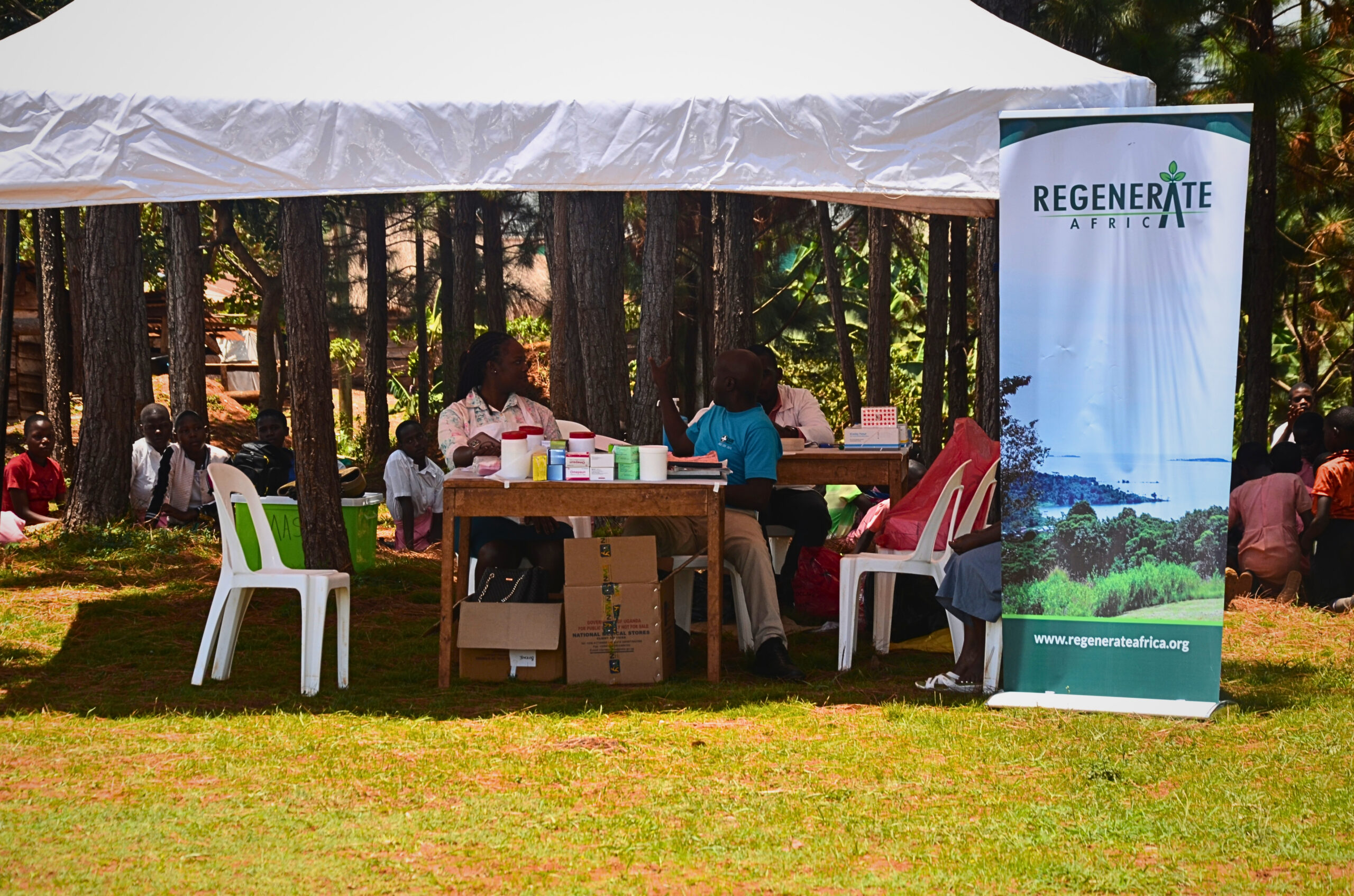
On Wednesday 7 October, Zzitwe Primary School became a community clinic for the day. Residents arrived in large numbers, and health workers from Ssi Bukunja Health Centre worked alongside the Regenerate Africa team, offering services that included malaria testing and treatment, HIV counselling and testing, family planning services and blood pressure screening, together with health education.
Local leaders stood with the team throughout. The LC Chairperson, sub-county officials and community development leaders urged residents to make full use of the services on offer, so that no one went home without care, and to share what they learned with their families and neighbours. The LC Chairperson also reminded everyone to collect a water filter before leaving the camp, linking treatment to prevention. Their presence mattered. When trusted local voices vouch for a service, people come forward, and the benefit reaches further than a single day.
The community sets the agenda
The most revealing moment was not at the registration desk. It came when the Regenerate Africa Health Promotion Educator opened a discussion and asked residents what worries them most. The answers came openly: safe drinking water, hygiene and sanitation, malaria, malnutrition and a changing environment.
Leaders drew the links. The Sub-County Chief, Mr. Bakubajja Ronald Salongo, acknowledged the Regenerate Africa signpost message, “Conserve the environment and the environment will save you,” and explained that many of the illnesses affecting people result from the way the environment has been spoiled. Changing seasons, poor harvests, hunger and disease, he said, are one story. Mr. Ssemejja Medi, representing the Community Development Officer of Ssi Sub-county, made the same point from the household’s side: when people are unwell they cannot go to their gardens, which hurts income and food security. He urged residents to share what they learn with their families and neighbours.
The Chief also welcomed how far the outreach had travelled. Ssi Health Centre III is far from many villages, he noted, and Regenerate Africa had taken services beyond what the community expected. When people are healthy, he said, they do not need to spend heavily on health care, so prevention saves money for households. He also appreciated another message on the signpost: “As you prepare for your children, prepare to conserve the environment.”
Safe water, delivered to the doorstep
Alongside the outreach, the team carried out one more activity that families had long been asking for: the distribution of household water filters in Zzitwe and Kkoba parishes.
Water can look perfectly clear in the cup and still carry the germs behind diarrhoea, typhoid and cholera, illnesses that keep children out of class and parents out of their gardens. Filters have already been placed in households under the PHE model, and the need has not faded. It has grown. More families now ask for a filter of their own, and demand is bigger than the project can currently meet.
For a household, the difference is simple. A mother can give her children a safe glass of water. A family spends less on preventable illness. A child stays well enough to learn.
In Kkoba, our Community Liaison Officer gave a refresher training on how filters work and how to keep them clean. When she asked participants which illnesses come from dirty water, they answered without hesitation: diarrhoea, cholera, typhoid, dysentery and worm infections. The Kkoba Chairperson thanked residents for turning out in large numbers and urged households to go beyond the filter itself, keeping the jerrycans that hold their drinking water clean, because a filter protects people only if the water is stored and handled safely afterwards. He also asked Regenerate Africa to keep supporting communities at the Ssenyi landing site, where hygiene and sanitation need more attention.
What this visit tells us
Three lessons stand out. First, bringing care close to people changes who can access it. Second, communities already know their priorities, and listening is part of delivering health. Third, health is not found only in hospitals. It is built in the water families drink, the soil they farm and the habits they share, and it grows when communities, leaders and health workers show up together.
Be part of it
The families of Zzitwe and Kkoba are showing what is possible when health is built from the ground up, and there are more households still waiting. If you work in health, water, education or community development, partner with Regenerate Africa to bring care and safe water to more communities. If you train future health workers, send your students to learn alongside communities. And if this story moved you, share it with someone who can help it travel further.